How to Make Your Own Minecraft (Without Coding)
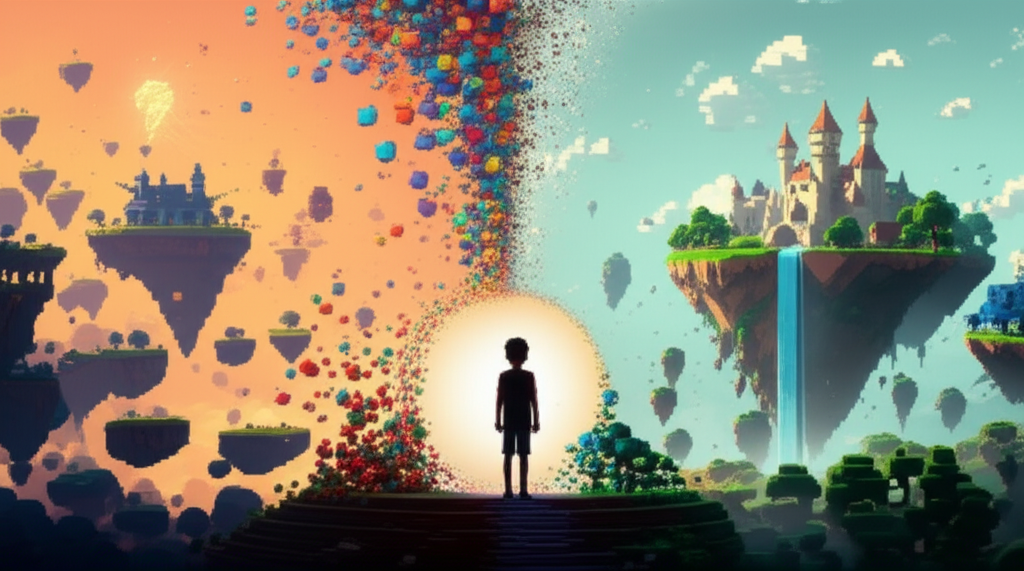
You've imagined it a hundred times. A world where the rules are yours. Where the dragons are rideable, the potions grant flight, and the survival mechanics work exactly the way you've always wished they would.
Maybe it's a competitive arena where everyone starts with random superpowers. Or a mystery world where every cave hides a puzzle. Or simply Minecraft, but with your twist—the version that exists only in your head.
The problem? Making that game seemed impossible. You'd need to learn programming. Spend months—maybe years—studying Unity or Unreal Engine. Write thousands of lines of code.
According to a recent Fast Company survey, 19% of Gen Alpha kids want to be game developers. That's nearly one in five children dreaming of creating their own games. And in online communities like Reddit's r/VoxelGameDev, posts like this appear constantly:
"I want to make my own Minecraft clone but I have zero coding knowledge. Where should I begin?"
The answer, until recently, was brutal: spend years learning to code, or give up the dream.
But that answer is changing. Fast.
Why People Want to Make Their Own Minecraft
Let's acknowledge something: Minecraft is already infinitely customizable. Mods exist. Servers exist. Why would anyone want to make "their own"?
Because there's a difference between configuring someone else's creation and creating something yourself.
The Modding Limitation
Minecraft modding is powerful, but it has real constraints:
- You're still in Minecraft's world. The aesthetics, the core mechanics, the fundamental "feel" is set.
- Mods break. Every Minecraft update can shatter your carefully curated mod collection.
- Complexity accumulates. Managing dozens of mods, configs, and compatibility issues becomes a second job.
- Distribution is hard. Getting friends to install the same modpack with the same versions is a support nightmare.
What People Actually Want
When someone says "I want to make my own Minecraft," they usually mean:
- Complete creative control. Not just changing textures—fundamentally reimagining how the game works.
- Something shareable. A game they can give to friends with a single link.
- Something that's theirs. Not "Minecraft with extra mods"—a creation with their name on it.
- Something playable now. Not after two years of learning C#.
The Traditional Path (And Why It Doesn't Work)
Option 1: Learn Unity or Unreal
The "correct" answer, if you ask game development forums. Download Unity. Learn C#. Study 3D mathematics. Understand rendering pipelines. Build systems for inventory, physics, world generation, multiplayer networking...
Realistic timeline: 2-5 years to build something resembling a playable voxel game.
Option 2: Use a Voxel Engine Framework
Options like SunVox, VoxelJS, or CubeWorld-style engines let you skip some work. But you still need programming knowledge. You're still writing code. The barrier is lower, but it's still there.
Realistic timeline: 6 months to 2 years, assuming you can code.
Option 3: "No Code" Game Makers
Platforms like GameMaker, Construct, or RPG Maker lower the barrier further. But they're designed for 2D games, platformers, or specific genres. Building a 3D voxel sandbox? Not really what they're for.
Enter Vibe Coding: The New Path
There's a phrase gaining traction in the AI development world: vibe coding. Coined by Andrej Karpathy (former head of AI at Tesla), it describes a new way of building software:
"...fully giving in to the vibes, embrace exponentials, and forget that the code even exists."
The idea: you describe what you want, and AI handles the code. You focus on the what, not the how.
How This Applies to Game Creation
Instead of learning Unity and C#, imagine describing your game: "A survival voxel world where gravity reverses every 10 minutes. Players can build upward or downward. Combat uses throwable blocks. The goal is to reach the floating temple in the sky."
And then: it exists. Playable. Shareable. Yours.
This isn't science fiction. It's what tools like Vibeforge are building right now.
Getting Started with Vibeforge
Vibeforge is designed specifically for this use case: turning your game idea into a playable reality, without coding.
The Process
- Describe your vision. What's the core mechanic? What makes your game unique?
- Iterate on the details. Clarify rules, behaviors, and edge cases through conversation.
- Generate and play. Your game is created and ready to test.
- Share with anyone. Friends get a link. That's it.
Ready to make your own Minecraft? Join the Vibeforge waitlist and be among the first to turn your game idea into reality.
Frequently Asked Questions
Can I really make a game without coding?
Yes. You describe what you want, the AI generates the implementation.
Will my game look like Minecraft?
It's voxel-based with similar aesthetics, but your rules, your mechanics, your vision.
Can I play with friends?
Absolutely. Vibeforge generates shareable games that friends can join.
Ready to build a server or world?
Join the waitlist for early access. Pick a workload, start from a template, and iterate by chatting.